
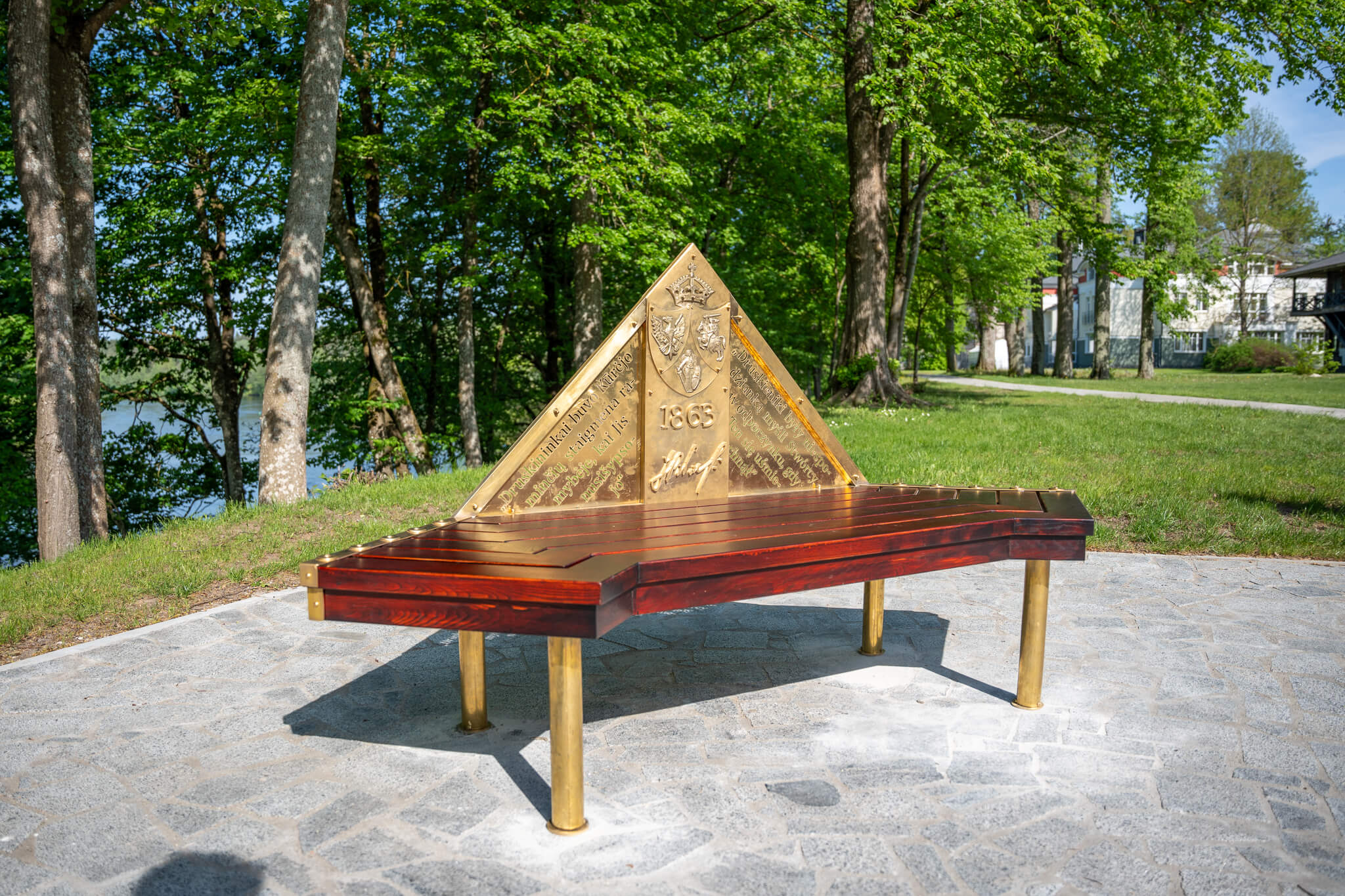
A commemorative bench for the Polish community
Druskininkai is the oldest operating spa town, founded on 20 June 1794 by order of Stanislovas Poniatowski, Grand Duke of Lithuania. The area now occupied by the town has been inhabited since ancient times, with three main communities living and developing within its boundaries: people of Polish, Jewish and Lithuanian origin. In 1863, groups of insurgents were active in the Druskininkai area. During the interwar period, Druskininkai belonged to Poland (1920–1939). During that period, the resort was made particularly popular by Józef Piłsudski, who spent a large part of his summer holidays here. Druskininkai was home to such notable figures as the Lithuanian painter and composer M.K. Čiurlionis, the sculptor Ž. Lipšicas, K. Dineika, founder of the Druskininkai Park of Therapeutic Physical Culture and Climate Therapy, and the renowned doctor I. Fonberg. To mark the town’s 230th anniversary and in honour of these figures, Druskininkai has adorned the resort’s public spaces with four sculptural benches, created by the renowned Lithuanian sculptor Romualdas Inčirauskas. On the initiative of the Druskininkai Rotary Club ‘Sūrutis’, another sculpted bench has been created, dedicated to the Polish community in Druskininkai. These are famous people who lived here, created works here and helped to promote the resort: the Polish writer E. Ožeškova, the poet J. Čečiotas, the writer J. I. Kraševskis, and the well-known historical figure J. Pilsudskis, an honorary citizen of Druskininkai during the interwar period. The bench-sculpture depicts the coat of arms of the 1863 Uprising, which symbolises the unity of the three nations (Lithuanians, Poles and Ukrainians) in their struggle against the threat of Tsarist Russia, which remains relevant to this day. Also framed on the bench are some beautiful thoughts by J. Pilsudski about the town of Druskininkai. He loved Druskininkai and wrote in his memoirs: ‘Druskininkai was a surprise from the Creator’s thoughts in tranquillity, when he smiled’. The bench is situated in a very beautiful spot, on the banks of the Nemunas, at the site of J. Piłsudski’s former summer residence.


