
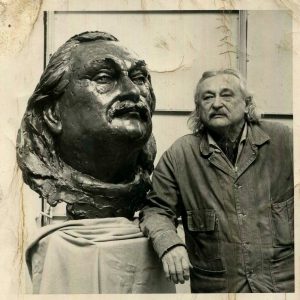
However, Lipchitz’s artistic trajectory underwent a significant shift from 1930 onwards, one which was marked by a departure from strict geometric planes to embrace sleeker, rounder forms which were infused with plasticity. His sculptural silhouettes began to meander and pulsate, showcasing a new creative direction.
Lipchitz passed away on 16 May 1973 in Capri, Italy. Following his death, his remains were laid to rest in Jerusalem.
The sculptor’s major awards include:
- Medal of achievement (1969), American Institute of Architects, New York
- Award of merit (1969), Yeshiva University medical centre, New York
- Gold medal (1966), Academy of Arts and Letters, New York
- Award for cultural achievement (1965), Boston University, Boston
- Honorary Doctor of Laws (1965), Jewish Theological Seminary, New York
- Brandeis ‘Creative Arts Award for Distinguished Contribution to the Arts’, Brandeis University, Waltham (1958)
- The George D Widener memorial gold medal for the sculpture, ‘Prometheus Strangling Vulture’ (1952), Pennsylvania Academy of the Fine Arts, Philadelphia
- Order of the Legion of Honour of France, Paris (1946)
- Gold medal for the sculpture, ‘Prometheus Strangling Vulture’ (1936), World’s Fair, Paris
- First prize in the sculpture category (1909), Académie Julian, Paris.