Works by internationally renowned sculptor Jacques Lipšić return to his native Druskininkai
The motto of this year’s “Druskininkai – Lithuanian Capital of Culture 2025” – “Touched by Čiurlionis” – echoes well the already textbook Ž. “(…) Čiurlionis was a true genius. And I am proud to have been born in a village whose soil his feet touched. Our dear, unforgettable Druskininkai”.
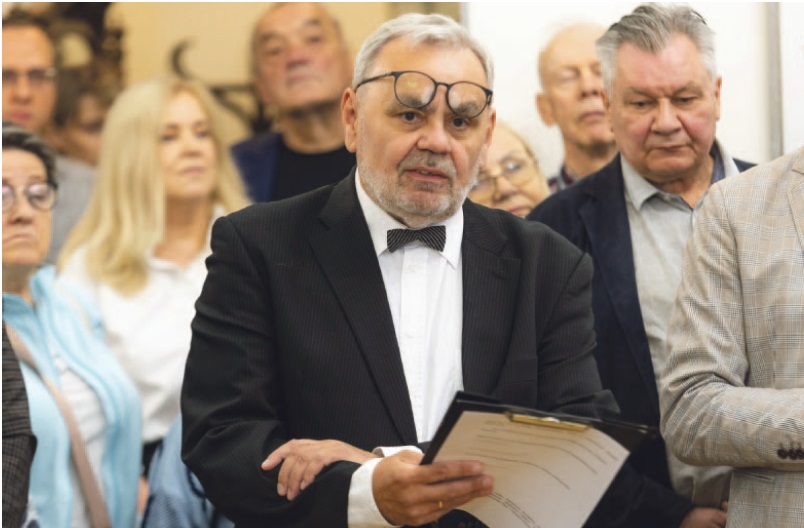
Last week the exhibition “Back to Druskininkai” opened at the Druskininkai City Museum, featuring sculptures, drawings and lithographs by the world-famous Lithuanian artist Jacques Lipshits, a native of Druskininkai, as well as paintings, drawings, lithographs and sculptures by another famous artist, Theo Tobias, from the collection of Dr Shmuel Tatz. This is the first exhibition of Jacques Lipshitz in his native Druskininkai.
The event was opened by harpist Joana Daunite, whose, according to Gintaras Dumčius, Director of the Druskininkai City Museum, harp sounds captured by her fingers filled the space with the music so beloved by Jacques Lipšitz. Lipshitz. Lipshitz. The live music of the harp seemed to come alive and speak through the sculpture “Harpists”, a sculpture of an important turning point in Lipšić’s career, the image of which was chosen to invite the works of two famous Litvaks, Žakas Lipšić and Teo Tobias, to the exhibition. “Back to Druskininkai!” – a phrase that seems to have wings, just like the sculpture depicting two harpists forming a bird with outstretched wings, ready to fly.
On a rainy afternoon, the Mayor of Druskininkai Richardas Malinauskas, collector Dr S. Takas and academician Professor Antanas Andrijauskas welcomed the audience to the city museum.
“This is indeed an important event for Druskininkai, which this year wears the crown of the Lithuanian Capital of Culture,” said G. Dumčius, “and for me personally it is the fulfilment of a promise made to the sculptor’s daughter Lola Lipšice, who visited the museum 22 years ago. “Thank you for your warm hospitality! I hope to return and visit my father’s hometown again.”
And her hope of returning was fulfilled.
The exhibition “Back to Druskininkai” – is also a tribute to Dr Samuel Tatsu, a renowned collector of Lithuanian art who amassed the finest personal collection of Lithuanian art in the world. Born in Alytus, spending many years in Druskininkai, communicating and learning the subtleties of the profession from the famous Karolis Dineika, Dr Samuel Tatz returned to Druskininkai with a significant part of his collection, which is important for the people of Druskininkai. Lipščić (1891-1973) and Theo Tobias (1927-2012).
The organisers of the exhibition thanked Dr S. Tatsis for his love of Druskininkai, his love of art and for providing the exhibits.
The exhibition will be open at the Druskininkai City Museum until 30 September.
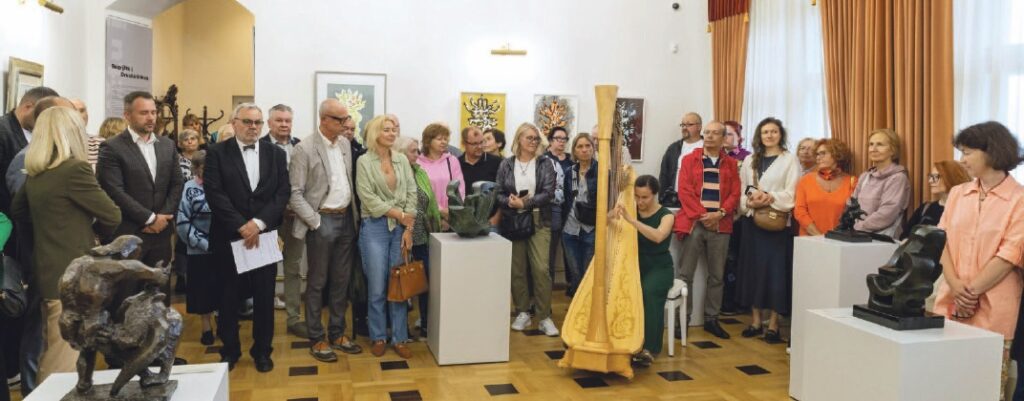
Photos by Alvydas Lukosevicius – fragments of the event
Dossier
Born in Druskininkai, Lithuania in 1891 to a Litvak family, Haimas Jakobas Lipshits travelled to Paris in 1909 to study at the École des Beaux-Arts and the Académie Julian. Lipshitz was involved in the Montmartre art community and became friends with Pablo Picasso, Juan Gris, Diego Rivera, Amedeo Modigliani and others. In 1913, inspired by Picasso and fellow sculptor Alexander Archipenko, he began to create his first cubist works. In 1916 Lipschitz signed a contract with the influential art dealer Léonce Rosenberg, and in 1920 held his first solo exhibition at Rosenberg’s gallery L’Effort Moderne.
In the mid-1930s Lipschitz began to move away from Cubism and towards a figurative, emotionally expressive style – openwork sculptures that fit into the surrounding landscape. In 1930 Lipschitz had his first major retrospective at Jean Boucher’s Renaissance Gallery, and in 1937 his monumental Prometheus Strangling a Vulture was exhibited at the World Exhibition in Paris. In 1940, the Nazi occupation forced the sculptor to leave Paris, and the following year he found refuge in New York. Thereafter, Lipschitz became increasingly interested in mythological, biblical and universal themes, Jewish religious life and the exploration of Judaism in his work. In 1946 Lipschitz was made a Chevalier of the Legion of Honour, and in 1954 the Museum of Modern Art in New York held a retrospective exhibition of his work, which was subsequently exhibited at the Walker Art Center in Minneapolis and the Cleveland Museum of Art. Lipshitz died in 1973 in Capri, Italy, and was buried in Jerusalem. Today, his work is collected by numerous institutions around the world: the Metropolitan Museum of Art and the Museum of Modern Art in New York, the Art Institute of Chicago, the Philadelphia Museum of Art, the G.K. Walker Art Center in Minneapolis, the National Gallery of Art in Washington, D.C., the Tate Modern in London, the Centre Pompidou in Paris, and the Tel Aviv Museum of Art.
The exhibition in Druskininkai features six works by G. K. Woker. The Salisbury exhibition includes six bronze sculptures by Lipschitz – Harpists 1930, Guitar Playing 1922, etc.; 1 ink drawing and 15 lithographs from two cycles – The Tree of Life and 12 Drawings for Prometheus – as well as 10 paintings, 1 bronze sculpture, 1 drawing and 5 lithographs by Theo Tobiasse.
Information for “Mano Druskininkai”